
market cap of all cryptocurrencies
- Are all cryptocurrencies the same
- Value of all cryptocurrencies
- Do all cryptocurrencies use blockchain
Market cap of all cryptocurrencies
Cryptocurrency mining is the process of adding new blocks to a blockchain and earning cryptocurrency rewards in return. Cryptocurrency miners use computer hardware to solve complex mathematical problems mobile casino free signup bonus. These problems are very resource-intensive, resulting in heavy electricity consumption.
If you want to buy a particular cryptocurrency but don’t know how to do it, CoinCodex is a great resource to help you out. Find the cryptocurrency you’re looking for on CoinCodex and click the “Exchanges” tab. There, you will be able to find a list of all the exchanges where the selected cryptocurrency is traded. Once you find the exchange that suits you best, you can register an account and buy the cryptocurrency there. You can also follow cryptocurrency prices on CoinCodex to spot potential buying opportunities.
The total crypto market volume over the last 24 hours is $172.65B, which makes a 34.94% increase. The total volume in DeFi is currently $27.22B, 15.77% of the total crypto market 24-hour volume. The volume of all stable coins is now $161.34B, which is 93.45% of the total crypto market 24-hour volume.
NFTs are multi-use images that are stored on a blockchain. They can be used as art, a way to share QR codes, ticketing and many more things. The first breakout use was for art, with projects like CryptoPunks and Bored Ape Yacht Club gaining large followings. We also list all of the top NFT collections available, including the related NFT coins and tokens.. We collect latest sale and transaction data, plus upcoming NFT collection launches onchain. NFTs are a new and innovative part of the crypto ecosystem that have the potential to change and update many business models for the Web 3 world.
Are all cryptocurrencies the same
We are “testing the waters” under Regulation A under the Securities Act of 1933. The information contained on the Masterworks.io website has been prepared by Masterworks without reference to any particular user’s investment requirements or financial situation. Potential investors are encouraged to consult with professional tax, legal, and financial advisors before making any investment into a Masterworks offering. All investments involve risk, including the risk of the loss of all of your invested capital. Please consider carefully the investment objectives, risks, transaction costs, and other expenses related to an investment prior to deciding to invest. Diversification and asset allocation do not ensure profit or guarantee against loss. Investment decisions should be based on an individual’s own goals, time horizon, and tolerance for risk.
Digital currencies are assets that are only used for electronic transactions. They do not have any physical form, although they can be exchanged for regular money or other assets. Although the most popular digital currencies are cryptocurrencies like bitcoin, many national governments are considering issuing their own centralized digital currencies.
Since its creation in 2009, Bitcoin (CRYPTO:BTC) has become a revolutionary digital currency. Because it enables peer-to-peer payments without a third party (like a bank), it has set off a tidal wave of other cryptocurrencies and digital assets making use of blockchain technology.
The first thing that makes crypto projects different is their status as legitimate cryptocurrencies. If you don’t know what this means, compare what you already know about Bitcoin to what the press has told us about Facebook’s Libra. Bitcoin is a legitimate cryptocurrency through and through. Libra may not be, depending on what it looks like when it is finally launched.
Generally, the central bank of a nation is the authority for issuing CBDCs. You can think of Central Bank Digital Currencies as the fiat currency of a country in the digital form. The government’s backing ensures that CBDCs enjoy wider adoption and can be used for daily transactions.
Value of all cryptocurrencies
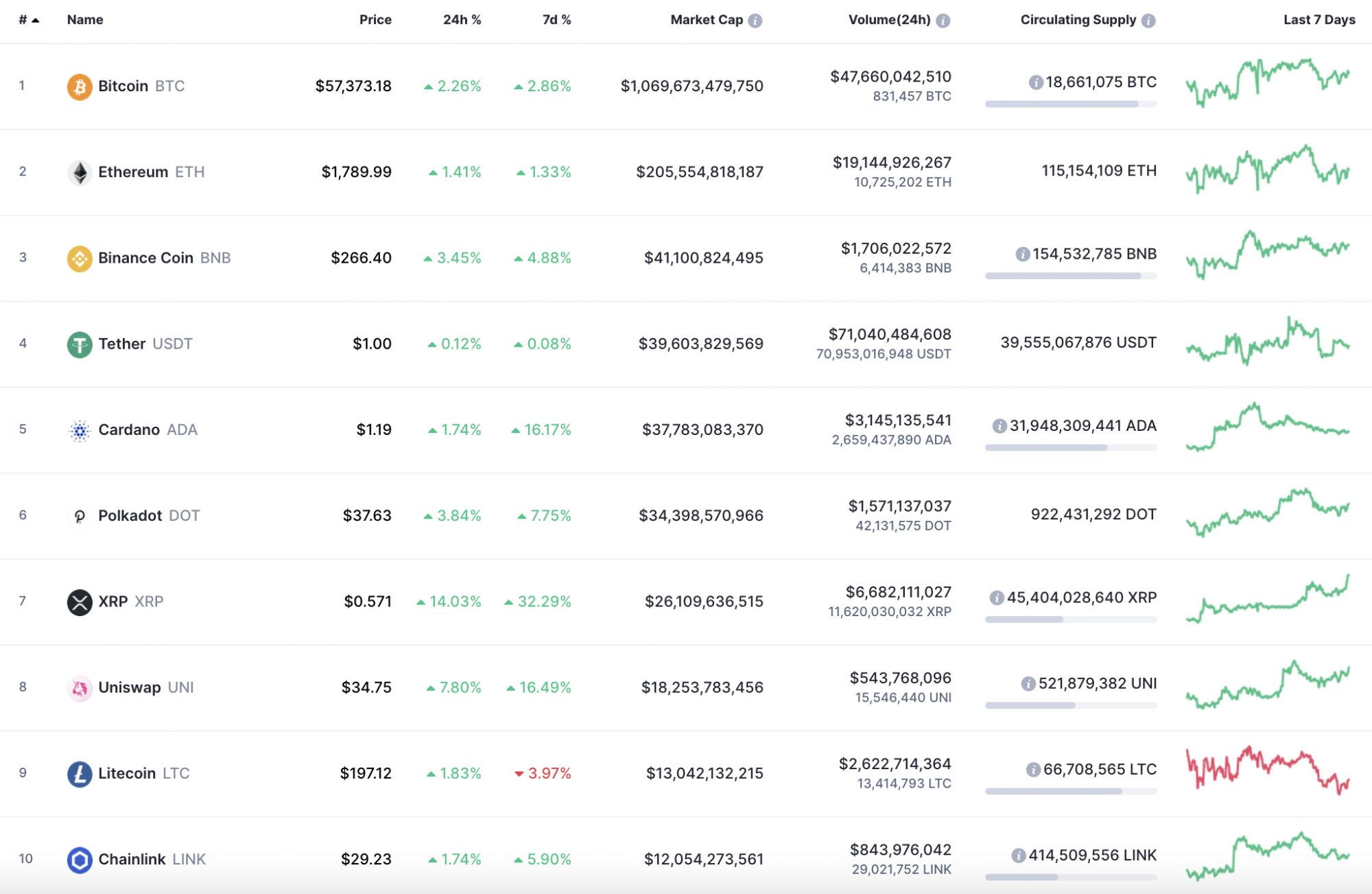
These crypto coins have their own blockchains which use proof of work mining or proof of stake in some form. They are listed with the largest coin by market capitalization first and then in descending order. To reorder the list, just click on one of the column headers, for example, 7d, and the list will be reordered to show the highest or lowest coins first.
Cryptocurrency market capitalization (market cap) refers to the total value of a particular cryptocurrency that is currently in circulation. It is calculated by multiplying the current market price of a cryptocurrency by the total number of coins or tokens that have been issued. The total market capitalization of all cryptocurrencies for today is $3,483,735,942,412
Cryptocurrency prices are affected by a variety of factors, including market supply and demand, news, and government regulations. For example, news about developments in a cryptocurrency’s underlying technology can affect its price, as can news about government regulations. Also, the supply and demand of a particular cryptocurrency can affect its price. Finally, market sentiment and investor confidence in a particular cryptocurrency can also play a role in its price. We cover sentiment and technical analysis for example you can check top coins : Bitcoin, Ethereum, XRP, Cardano, Dogecoin.
Price volatility has long been one of the features of the cryptocurrency market. When asset prices move quickly in either direction and the market itself is relatively thin, it can sometimes be difficult to conduct transactions as might be needed. To overcome this problem, a new type of cryptocurrency tied in value to existing currencies — ranging from the U.S. dollar, other fiats or even other cryptocurrencies — arose. These new cryptocurrency are known as stablecoins, and they can be used for a multitude of purposes due to their stability.

These crypto coins have their own blockchains which use proof of work mining or proof of stake in some form. They are listed with the largest coin by market capitalization first and then in descending order. To reorder the list, just click on one of the column headers, for example, 7d, and the list will be reordered to show the highest or lowest coins first.
Cryptocurrency market capitalization (market cap) refers to the total value of a particular cryptocurrency that is currently in circulation. It is calculated by multiplying the current market price of a cryptocurrency by the total number of coins or tokens that have been issued. The total market capitalization of all cryptocurrencies for today is $3,483,735,942,412
Do all cryptocurrencies use blockchain
Coins are built on their own blockchain and were originally intended as a form of currency. Generally, any blockchain-based cryptocurrency that is not Bitcoin is referred to as an altcoin (more on those below). A digital coin is created on its own blockchain and acts much like fiat (traditional money).
As mentioned above, blockchain could facilitate a modern voting system. Voting with blockchain carries the potential to eliminate election fraud and boost voter turnout, as was tested in the November 2018 midterm elections in West Virginia.
At its core, blockchain is a type of database or ledger that records transactions across multiple computers in a secure and transparent manner. Unlike traditional centralized databases, blockchain is decentralized. This means no single entity has control over the data, making it harder to tamper with.
If Solana can rise to prominence among the leading blockchains, it could become a leading solution for decentralized finance services and low-fee payment solutions. This way, it could achieve a price of $1,000 per Solana token and a $400 billion market capitalization.
Supply chains involve massive amounts of information, especially as goods go from one part of the world to the other. With traditional data storage methods, it can be hard to trace the source of problems, like which vendor poor-quality goods came from. Storing this information on blockchain would make it easier to go back and monitor the supply chain, such as with IBM’s Food Trust, which uses blockchain technology to track food from its harvest to its consumption.